MHW-3BOMBER - May 27 2026
Rethinking the Milk Pitcher in Titanium

Some objects become invisible through familiarity.
The milk pitcher is one of them.
It exists in cafés, competition spaces, and increasingly, at home — used every morning, trusted completely, rarely reconsidered. For decades, stainless steel has defined what a milk pitcher should be: practical, durable, efficient.
And for a long time, that was enough.
But coffee culture has evolved beyond function alone. Today, both professional baristas and home brewers care deeply about how tools feel to use — not just how they perform.
That was the starting point for this project.
Not to redesign the milk pitcher into something unfamiliar.
But to ask a quieter question:
How much can material change the experience of a familiar tool?

Material as Part of the Ritual
Most coffee tools are judged by performance first.
Can it pour well?
Can it steam consistently?
Can it survive daily use?
Those things matter. But materials shape experience long before specifications do.
Weight changes movement.
Texture changes grip.
Balance changes flow.
Even subtle differences can completely change how a tool feels in the hand.
Titanium interested us because it changes those sensations without demanding attention.
At under 180g, the pitcher feels noticeably lighter in motion than traditional stainless steel. During longer café shifts, repetitive practice sessions, or even slower mornings at home, that reduction changes the rhythm of pouring in a surprisingly natural way.
Quicker to move.
Less fatiguing.
More connected to the hand.
And after enough time using it, traditional steel begins to feel unexpectedly heavy.


Why Titanium
Titanium is often associated with aerospace engineering, medical equipment, and high-performance outdoor gear because of its strength-to-weight balance.
What interested us was something simpler.
Pure titanium is naturally corrosion-resistant, non-reactive, and uncoated. No paint. No interior lining. Just the material itself.
Milk is delicate. Especially in modern specialty coffee, where sweetness and texture matter more than ever. We wanted a material that interfered less with that experience — physically and sensorially.
Cleaner.
Lighter.
More natural to use.
A Surface Formed by Heat
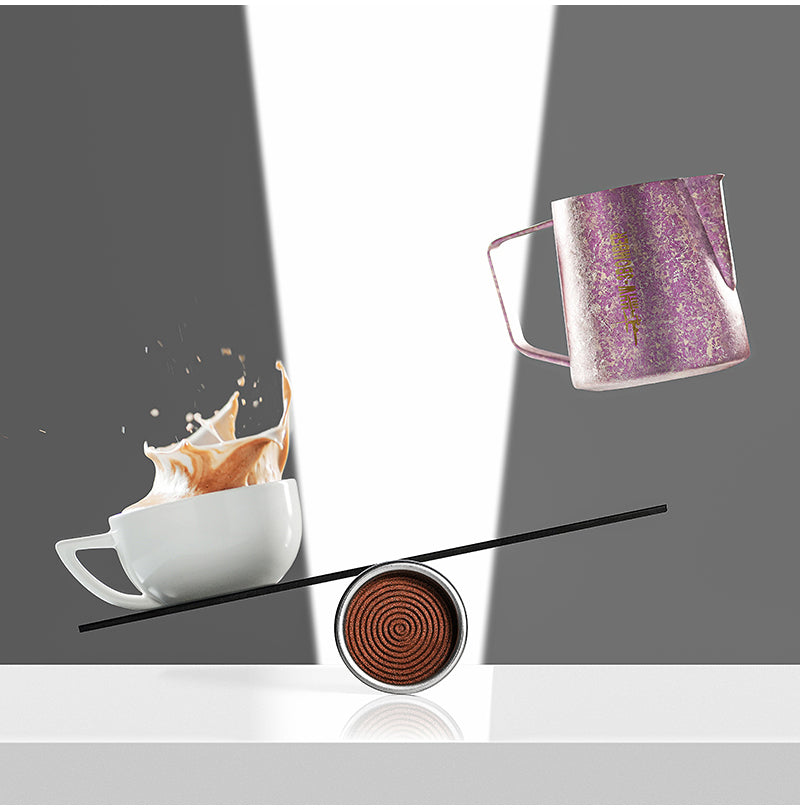
Each pitcher undergoes a crystallization process at temperatures exceeding 1000°C.
Under extreme heat, the titanium develops naturally occurring crystal textures directly within the material itself, forming a protective crystalline layer without artificial coating or printed finishes.
The patterns emerge differently on every piece. Some resemble frost, others feel almost cosmic under light.
No two are exactly alike because the texture is not applied onto the surface — it comes from the material itself.
For those who prefer a quieter look, the Silver Armor finish offers a softer matte titanium-grey expression while preserving the same material philosophy underneath.
Designed to Disappear Into Workflow

A milk pitcher should feel intuitive, whether you are steaming hundreds of drinks in a café or practicing latte art at home late at night.
The spout geometry was refined for cleaner latte art definition and smoother flow control.
The body proportions encourage more even milk circulation while steaming, while dual internal measurement lines simplify workflow without unnecessary visual clutter.
An angled bottom helps reduce wasted foam near the final pour, and the reinforced 1mm wall construction improves rigidity while preserving the lightness that makes titanium feel unique in the first place.
None of these details exist to call attention to themselves.
The best tools rarely do.
Over time, they simply become part of the ritual.

Rethinking Familiar Tools
Innovation does not always need to be louder or more complicated.
Sometimes it begins by reconsidering an object people stopped questioning a long time ago.
The milk pitcher is simple. Which is exactly why every detail matters.
Every curve affects movement.
Every gram affects balance.
Every material affects feeling.
Titanium challenged us to rethink all of it — not to make the tool feel futuristic, but to make it feel lighter, cleaner, and more connected to the experience of making coffee itself.